Why Repetition Gives a Garden a Sense of Rhythm
Garden repetition connects separate views through recurring shapes, colors, or materials, while thoughtful variation keeps the design lively and natural.

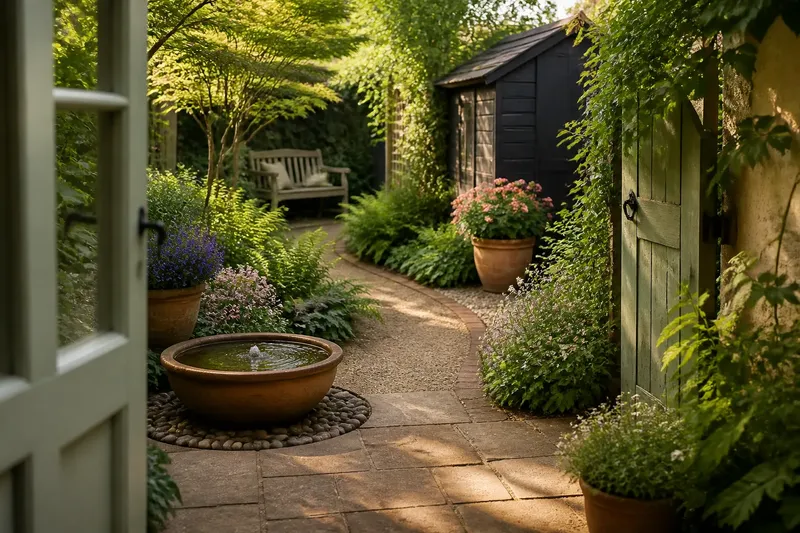
Garden repetition can make a path, patio, and planting bed feel like parts of one composition rather than separate scenes. Repeat a recognizable shape, color, or material, then vary its scale or setting so the eye finds a pattern without seeing a copy-and-paste border.
The useful question is not how many times to repeat something, but what should recur as a visitor moves through the garden. A rounded leaf, a muted blue flower, or a warm-toned timber edge can become a visual cue that carries the eye from one area to another.
What should repeat across separate garden views?
Choose one clear feature that already suits the site. Look from the kitchen window, along the main path, and from the place where people tend to sit. Note which shapes or colors appear naturally in more than one view, and consider developing one of them into a deliberate motif.
A motif might be a soft arch echoed in a trellis and a clipped shrub, or a particular foliage color that appears in a container near the entrance and a planting bed farther on. Repetition works best when the connection is easy to notice but does not demand attention.
Keep the motif simple enough to recognize at a glance. If a garden already has many strong colors and forms, use a quiet feature such as upright stems or rounded foliage. If the planting is restrained, a recurring flower color or a distinct geometric shape may provide the link.
How can a week of looking lead to a useful plan?
Use a week to observe the garden before buying plants or moving materials. Each day, look at the same views at roughly the same time. The point is not to record every detail; it is to notice what connects the spaces and where the visual sequence breaks.
- Day one: Sketch the main route and mark the views visible from doors, windows, and seating.
- Day two: List recurring shapes, such as upright grasses, domed shrubs, circular pots, or arched openings.
- Day three: Note color echoes, including foliage, flowers, painted wood, and containers.
- Day four: Look for materials that appear in more than one area, such as timber edging or a repeated metal finish.
- Day five: Choose one motif and mark where it already appears. Notice any long gap between appearances.
- Day six: Identify a possible place for one more echo, preferably where it would connect two views rather than add decoration to an already busy spot.
- Day seven: Review the sketch from the route a visitor would take. Keep the motif if it makes the sequence clearer; revise it if it dominates or disappears into the background.
Say you notice rounded foliage near the patio and at the garden entrance, but the middle of the path feels unrelated. You could sketch a rounded container or a suitable domed shrub near that transition, then check whether it links the two views without narrowing the route or crowding neighboring plants. The expected observable result is a more legible visual connection, not a row of identical forms.
How does variation keep a repeated motif alive?
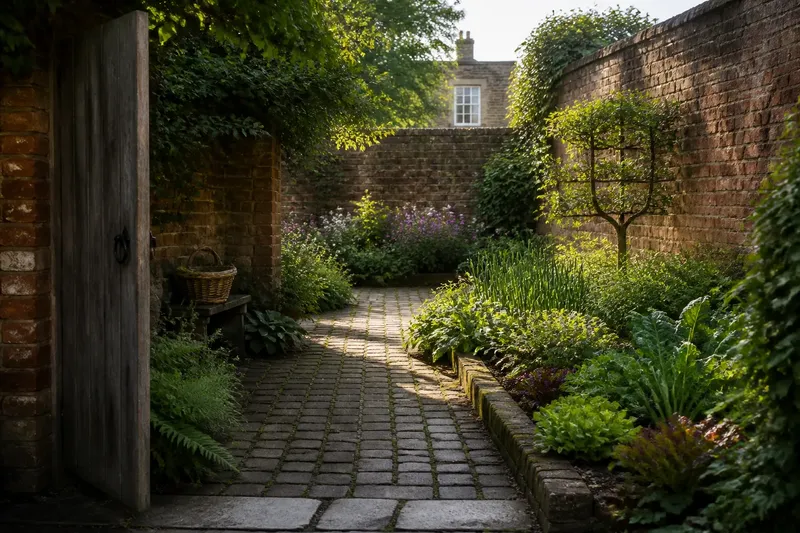
Repeat the feature, not every detail around it. A shape can recur at different heights; a color can appear in flowers, foliage, or a small object; a material can show up as an edge in one place and a frame in another. The eye recognizes the family resemblance, while the differences keep each view specific.
Spacing matters, too. Put echoes where one view leads naturally to the next, rather than at mechanically equal intervals. A motif can appear close together near a threshold and then return after a longer pause. That variation creates a sense of pace, much as a sentence uses both short and long phrases.
Try changing one quality at a time. If rounded forms repeat, vary their size or plant texture. If a blue-green color recurs, let one appearance be a broad patch and another a small accent. If several objects match in color and scale as well as shape, the pattern may begin to feel like a set rather than a garden.
When does repetition become too mechanical?
A repeated feature can feel forced when it competes with the site, repeats too tightly, or appears without a reason. Identical containers lined along every edge, for instance, can flatten a space that would benefit from a pause or a change in scale. Repetition should guide attention, not turn every corner into the same scene.
Before adding another echo, ask what it connects. If it links two views, clarifies a transition, or balances a strong form elsewhere, it may earn its place. If it merely fills a gap, try leaving the gap open. An unoccupied stretch can give the eye room to register the next appearance.
Also distinguish a useful motif from an accidental mismatch. A pale flower repeated in two beds may look unrelated if one planting is loose and airy while the other is tightly clipped. A shared outline, foliage quality, or supporting material might make the relationship clearer without forcing the beds into the same style.
How do you choose the right motif for your garden?
Can flowers alone create a repeating rhythm?
Yes, but a flower color may be seasonal and brief. Pair it with a recurring foliage tone, plant shape, or garden detail if you want the connection to remain visible beyond bloom time.
Should repeated plants be identical?
No. Related plants can share a form or texture while differing in height or flowering season. Check mature habit and site conditions before choosing; plant labels, supplier guidance, and local growing conditions should inform specific selections.
Can a small garden use more than one motif?
It can, but several competing motifs may make a compact space feel busy. Start with one dominant cue and add another only if it serves a distinct connection, such as tying a seating area to a boundary.
What if a repeated color is hard to see from a distance?
Make the echo larger, bring it closer to the route, or repeat a more visible shape alongside it. Step back to the viewpoints you use most and judge whether the link registers without searching for it.
How should the rhythm change as the garden grows?
Revisit the motif as plants mature and seasons shift. A young shrub may read as a small rounded accent, then become a substantial form that outweighs its echoes. Pruning, replacement, or moving a container can restore balance, but only after checking how the change affects the plant and its surroundings.
Notice which repetitions remain visible when flowers fade or foliage changes. A strong composition does not require every cue to be present at once. Garden repetition is most convincing when it offers a recurring note, then leaves enough room for each part of the garden to have its own character.