Gravel or Brick: What a Path Surface Adds to a Garden
Gravel or brick can change a garden path’s texture, pattern and visual weight; learn how to diagnose a surface that feels too busy, plain or out of place.
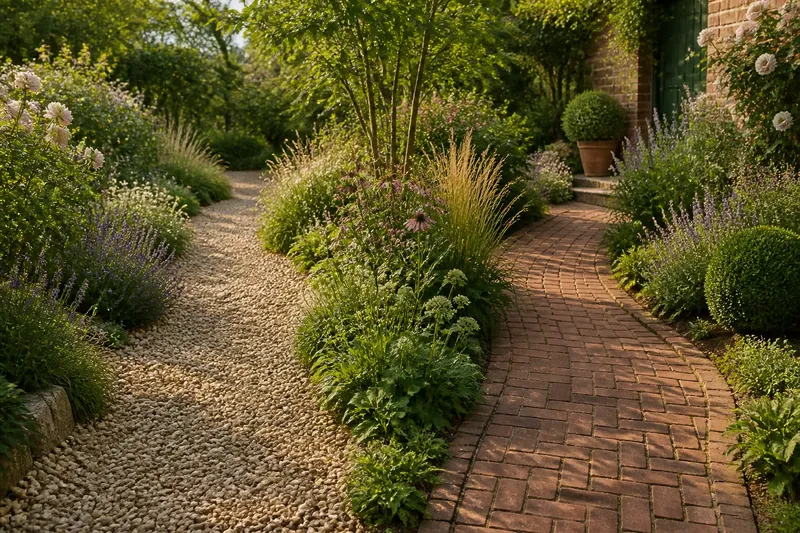
A gravel or brick garden path can make the same planting feel loose and natural or measured and architectural. The difference is not merely color underfoot: gravel scatters attention across many small marks, while brick gathers it into repeated edges and joints. If a path feels wrong beside a border, the cause may be this visual behavior rather than the plants themselves.
Read the surface as part of the garden’s composition. Notice how it looks from the doorway, from the path’s entrance and from the place where you pause. Then diagnose the specific mismatch before deciding whether the material, its pattern or its relationship to the surrounding shapes needs attention.
Why does the path seem busier than the garden?
Gravel can become the loudest texture in a view because its scattered highlights and shadows create countless small contrasts. Pale stones catch the eye in bright light; darker gravel can read as a dense, restless field against delicate foliage. Brick also has texture, but its edges and joints usually organize that texture into a more legible pattern.
Start by checking how much of the surface is visible at once. A broad gravel path seen from an upstairs window may look like a large, speckled shape, while the same material glimpsed between leaves can feel quiet and incidental. The path’s visual scale matters as much as its color.
If gravel dominates, try judging it from a closer viewpoint and from the angle where its surface is broken by planting, a bend or a threshold. If it still pulls more attention than the garden’s intended subject, consider a less contrasting stone color or a narrower visible band. Brick may suit a view that needs clearer edges, but a strongly contrasting brick can also draw the eye; changing materials is not automatically a cure for excess emphasis.
Why does brick look too formal beside soft planting?
Brick’s orderly joints can make informal planting appear more unruly by comparison. A straight run of crisp, uniform units sets up a clear visual rule. Loose grasses, spreading ground covers and irregularly shaped shrubs may seem to press against that rule rather than belong to it.
Look for a mismatch in shape and finish, not simply a clash of color. Smooth, sharply edged brick beside fine, wavering foliage creates a different impression from weathered-looking brick beside broad, relaxed leaves. The path may need a quieter pattern, a softer color relationship or a more deliberate transition where it meets planting.
Imagine a narrow side garden with a straight brick path and a border of airy grasses. If the path reads like a ruler laid through a loose planting, a gentler brick tone or a less emphatic joint pattern could reduce the contrast; the observable aim is for the edge to remain clear without becoming the view’s main line. If the path’s formality is useful near a doorway, keep that order there and let the planting become more relaxed farther along.
Why does gravel feel disconnected from the path’s edges?
Gravel’s loose visual texture can blur the boundary between walking surface and border. This is especially noticeable where plants spill across the edge, where a bed has a similarly fine texture, or where the path widens without a clear reason. Instead of reading as a route, the gravel can seem to dissolve into its surroundings.
Check whether the edge is legible from the garden’s main viewing position. A visible edging material, a change in planting height or a cleaner line where gravel meets a bed can help distinguish the path without making it feel fenced in. The decision depends on the character you want: a crisp boundary makes the route more graphic, while a softer edge lets it merge with the planting.
Brick naturally supplies repeated edges, but those lines can look abrupt if they stop against an irregular border. A restrained edge treatment or a small shift in the planting immediately beside it may help the two forms meet. Avoid adding a second strong border simply to make the first one more noticeable; too many outlines can fragment a small space.
Why does the path’s pattern fight the garden’s shapes?
Brick introduces a pattern whether or not it is meant to be the feature. Straight joints can reinforce a formal axis, while a more intricate arrangement draws attention to the pavement itself. Gravel has no comparable joint grid, but changes in stone size, color or visible edging can still create a pattern of their own.
Compare the path with nearby shapes. If the garden already contains strong straight lines, a pronounced brick layout may repeat them until the view feels rigid. If beds have sweeping curves, a straight-edged path can either provide a useful counterpoint or cut across the movement awkwardly. The question is whether the surface clarifies the garden’s shape or competes with it.
Try reading the path as a silhouette from a distance. A brick pattern that becomes a busy grid may need a simpler visual treatment; a gravel path that appears as one shapeless patch may benefit from a clearer outline or a more decisive curve. These are design adjustments to consider, not instructions for altering the construction.
What should you check before changing the surface?
Use a brief visual check to identify the actual source of unease before settling on gravel or brick. Look at the path in ordinary daylight, then from the views where it matters most. Keep the checks distinct: each points toward a different design decision.
- Surface area: Does the path occupy a large, uninterrupted part of the view? If so, consider reducing its visual weight through color or the amount that reads as a single plane.
- Texture contrast: Does the surface stand apart from nearby leaves, soil and stone? If the difference is too sharp, seek a closer tonal relationship rather than adding more detail.
- Edge clarity: Can you tell where the route ends and the planting begins? If not, clarify one boundary without outlining every bed and path.
- Pattern strength: Do joints, curves or edging compete with the garden’s larger shapes? If they do, simplify the most noticeable line or pattern.
- Viewpoint: Does the surface look composed from the doorway but confusing from a terrace or window? Prioritize the view you use and adjust the design to support that reading.
These checks may point to keeping the current material and changing its visual context. A gravel path can feel more intentional beside a defined edge; brick can feel less severe when its color sits comfortably with nearby materials. The useful choice is the one that solves the observed mismatch, not the one that follows a general rule about natural or formal gardens.
Which garden path surface suits your design?
Does gravel make a garden look more natural?
Gravel often gives a path a granular, informal character, but the surrounding shapes and color determine whether it feels at home. A sharply edged, high-contrast gravel path can look quite deliberate and graphic.
Does brick always look formal?
Brick’s repeated units create order, though color, surface character and pattern affect how strongly that order reads. A restrained brick tone can sit quietly beside planting rather than announce a formal scheme.
Can gravel and brick work together?
They can, when each material has a clear role, such as brick defining a threshold and gravel carrying the path beyond it. Keep the meeting point visually understandable so the change reads as a considered transition rather than an accidental patch.
How do I choose a path surface from a sample?
Look at the sample beside the garden’s foliage, edging and nearby hard surfaces, not in isolation. Consider both its close texture and the larger shape it will create when repeated across the path.
What does the path contribute to the whole view?
A path surface can steady a view, soften it or pull attention toward a turn. Gravel tends to offer dispersed texture and a less sharply patterned field; brick tends to give the eye repeated units and a more defined visual order. Neither quality is inherently better. The surrounding garden decides whether it reads as support or distraction.
When comparing gravel or brick, keep returning to one practical question: what should the path help the eye understand? It may clarify a route, separate a border from open ground or connect two distinct areas. Choose the surface whose texture and pattern make that relationship easier to read, then let the plants and larger garden shapes carry the rest of the view.