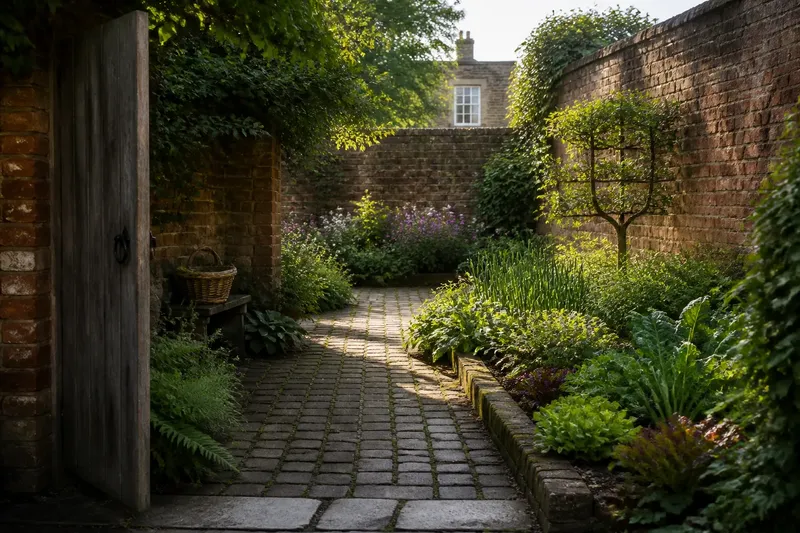
A Winter Garden Seen in Silhouette
A winter garden silhouette reveals how stems, branches and structures shape a view, helping you choose where to pause, look through or adjust a planting.
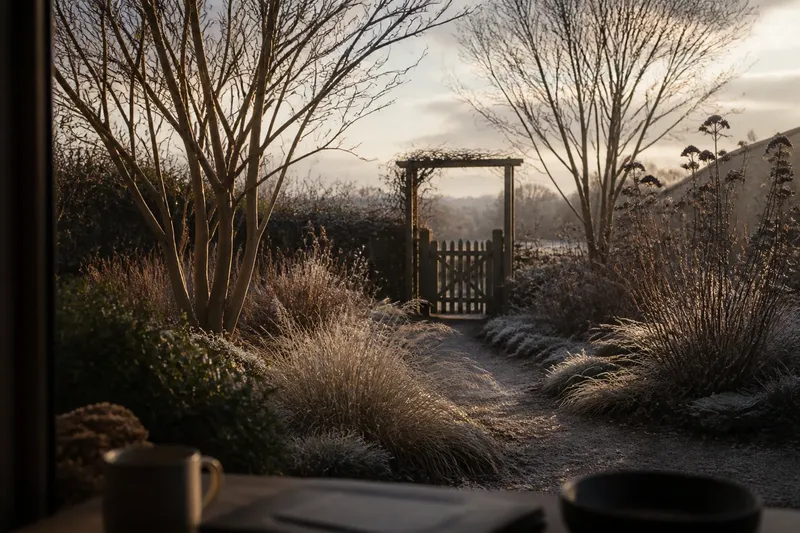
A winter garden silhouette can make a familiar border look newly arranged: without leaves, the eye follows stems, branch forks and the dark edge of a gate or trellis. The useful question is not simply which plants look attractive in winter, but what kind of outline you want the garden to offer from a particular place.
Try looking from a kitchen window, a path bend or a bench on a dull afternoon, when strong colour is scarce. Notice which forms stand apart, which merge into one another, and where a gap lets the eye travel farther. Those observations point toward three distinct approaches: a single sculptural outline, a layered view through several planes, or a more open frame that lets architecture and sky do the work.
Would one sculptural outline suit your view?
A single, legible form gives the eye a clear place to pause. This can be a multi-stem shrub with visible branching, a small tree with a lifted crown, or a clump of upright stems set against a pale wall. The aim is not to make one plant a permanent star. It is to give a particular winter view a shape that remains readable when flowers and foliage have gone.
Look for branching that can be understood from a distance. A trunk that divides into a few strong limbs may read clearly across a lawn; a dense knot of fine twigs may become a dark blur. Bark tone matters, too. A pale trunk against an evergreen hedge has a different clarity from dark stems set against a shadowed fence.
This approach suits a compact garden, a window with a narrow sightline, or anyone who wants a calm view rather than a tangle of competing forms. It can also work in a larger space if the chosen plant is seen against open sky or a simple background. Before changing anything, stand in the intended viewing spot and check whether the outline stays distinct as you shift your position slightly.
Pruning can reveal a plant’s natural framework, but it should not turn every shrub into a bare, geometric specimen. Remove only what is appropriate for that plant and season, and avoid cutting simply to force a silhouette that does not belong to its growth habit. If you are unsure about a plant’s pruning needs, follow its label or the grower’s instructions.
When does a layered silhouette make more sense?
Layering creates depth by placing several outlines at different distances: perhaps a foreground clump of grasses, a branching shrub beyond it, and a fence or tree line behind both. Each form need not be dramatic. The pleasure comes from seeing edges separate, overlap, and then separate again as you move through the garden.
This is a good fit for a long border, a view across a lawn, or a garden that feels flat in winter. Begin with the farthest plane. A hedge, wall or evergreen mass gives the eye a steady backdrop; a deciduous tree or shrub can then show its branching against that darker field. Lower stems in front add a nearer, finer texture without concealing the larger framework.
Keep the outlines varied in scale. A thicket of equally fine stems can become visual noise, while several broad, rounded masses may merge into a single block. A useful arrangement might combine one upright shape, one spreading branch pattern and one low, softly tufted form. Let some gaps remain: a clean opening between branches can make the depth of the view easier to read.
Imagine a narrow border seen from a dining-room window, with a dense evergreen hedge at the back and bare shrubs in front. If you thin the view by moving one small shrub and leave a gap between two branches, the expected result is a clearer glimpse of the hedge and a more distinct separation between near and far forms. That is an invented situation, but it illustrates a simple way to judge a change: decide what should become visible before moving or pruning anything.
Layering suits gardeners who enjoy a view that changes with their position. From one end of a path, branches may overlap; from a nearby doorway, a different opening may appear. It takes more attention to manage than a single focal outline, since each plant contributes to the whole. If the view feels crowded, first look for overlapping edges rather than assuming that everything needs cutting back.
Could an open frame be the better winter view?
Sometimes the most composed silhouette is not a plant at all. A pergola, arbor, gate, obelisk or the edge of a roof can frame bare branches and winter sky. These structures establish a strong line, while the plants within or beyond them provide softer, less predictable outlines.
An open frame suits a garden with a useful architectural feature, or a view where a dense planting would feel heavy. A simple wooden arbor can make an opening legible; a metal obelisk can give a climbing plant a clear vertical shape even when it is dormant. Keep the structure’s outline distinct from nearby branches. If their edges coincide, the frame may disappear into the planting rather than clarify it.
Think about the view from both sides of a structure. A gate that frames a distant tree from the path may look like a solid interruption from the other direction. The same feature can be a threshold, a backdrop or an object in its own right, depending on where you stand. That makes this approach especially useful for gardens with several entrances or a strong view from indoors.
Choose materials that remain visually quiet when the garden is bare. Weathered timber, dark-painted metal and unpainted willow each create a different edge against sky and stems. The decision is less about matching every garden feature and more about whether the frame should recede or announce itself. A bold structure can carry the view; a restrained one can leave the branching to lead.
How do you read a winter garden silhouette?
Where should you stand to judge the outline?
Use the place where you actually pause: a favorite window, a path entrance or a seat. Look at the view against the sky and again against a wall or hedge, because the same branches may read clearly in one setting and disappear in another.
What should you notice before pruning?
Trace the main stems from their base to their tips, then check where branches cross or merge with a background. Decide whether the plant needs a clearer outline, or whether the setting behind it is the real source of confusion.
Which plants make strong winter silhouettes?
Choose by visible form rather than a broad list of “winter interest” plants. Multi-stem shrubs, trees with open branching, ornamental grasses left standing, and climbers trained over a frame can all contribute, provided their shape suits the view and local growing conditions.
How can you tell whether the view is too busy?
Squint slightly or look from farther away so small details fall back. If several outlines merge into a single dark patch, consider opening a visual gap or simplifying one layer instead of removing every plant that contributes to the scene.
Which approach should you choose?
Let the viewing distance and the amount of visual activity decide. A single sculptural outline is easiest to read from a fixed window or a small courtyard. Layering offers more depth in a long view and rewards movement through the garden. An open frame is a natural choice when a gate, arbor or other structure already gives the space a useful boundary.
For a quick decision, ask what you want the eye to do. Pause on one form, travel through several planes, or look beyond a frame? Then check the answer from the spot that matters most, with the winter sky behind the shapes and with a darker backdrop behind them. A winter garden silhouette is not a separate seasonal decoration; it is the garden’s underlying structure made visible. Let that outline guide one small adjustment at a time, and leave room for the view to change as stems, weather and light shift.